How to outline a novel
Start with the ending, find the big turns, then fill in the scenes. It works whether you plan everything or almost nothing.
- Write the premise in one sentence: who wants what, and what stands in the way.
- Decide the ending first. It tells you what the middle is for.
- Find the five or six big turns, then fill in scenes between them.
- Give each scene two lines: what happens, and what changes.
Why outline at all
An outline isn't a contract. It's a map you're allowed to redraw. Its job is to prevent the two things that stop most first novels: the middle that sags and the ending you can't find.
You don't have to plan every scene. Even writers who discover the story as they go benefit from a few lines written down before they start. Ten minutes of outlining can save months of rewriting.
Step 1: Write the premise in one sentence
Use this shape: a character wants a goal, but an obstacle stands in the way, and if they fail, this is what they lose.
For example: "A retired ferry captain must find her missing grandson before the river freezes, but the only man who saw him is the one she sent to prison."
If you can't write this sentence yet, you have a situation, not a story. Keep working on it. Everything else hangs off it.
Step 2: Decide the ending
You don't need the details. You need to know whether your character gets what they want, and what it costs them.
Once you know where you're going, every scene either moves toward it or doesn't belong. The ending can change in revision, and often does. But a provisional ending gives the draft a direction.
Step 3: Find the big turns
Most stories that work share a handful of load-bearing moments, whatever you call them:
- The setup. Normal life, and what's wrong with it.
- The inciting incident. Something happens that the character can't ignore.
- The point of no return. They commit, and can't go back.
- The midpoint. A reveal or reversal that changes what the story is about.
- The low point. Everything they tried has failed.
- The climax. They face the central problem head on, and your ending plays out.
Write a sentence or two for each. That's the spine of your book.
Three-act structure, Save the Cat and the Hero's Journey are all ways of naming these turns. Use whichever vocabulary helps you think. Don't let a beat sheet push you into a shape your story doesn't want.
Step 4: Fill in the scenes
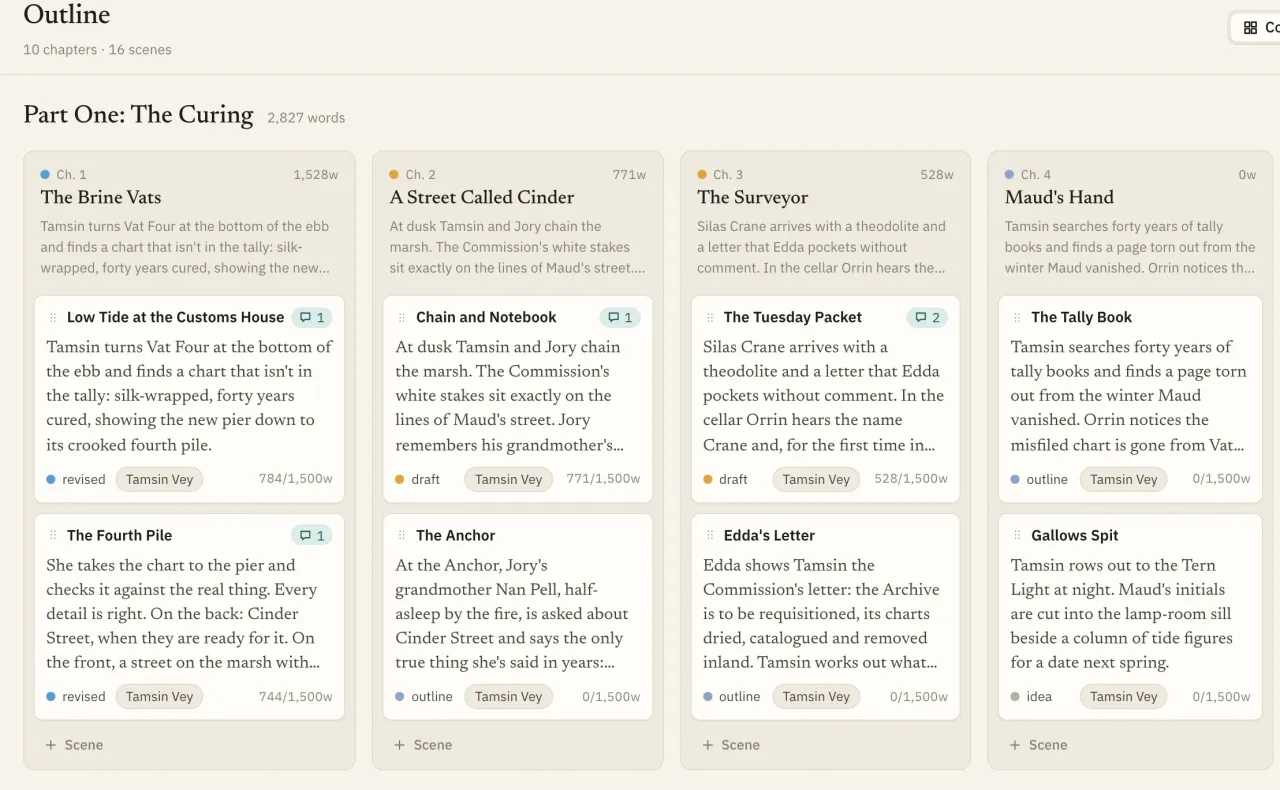
Now work between the turns. For each scene, write two lines: what happens, and what changes.
If nothing changes, no new information, no decision, no shift in who has the upper hand, the scene is probably summary pretending to be a scene. Cut it or fold it into another one.
A useful test: someone in the scene wants something, and by the end they get a yes, a no, or a "yes, but".
For scale, a 90,000-word novel often runs to 60 to 90 scenes. Don't plan them all at once. Plan the next act in detail and the rest loosely.
Step 5: Line up subplots and points of view
If you have more than one plotline or point-of-view character, lay them side by side: plotlines as rows, chapters as columns. Gaps jump out. The romance that vanishes for eight chapters. The villain who goes quiet for the whole second act.
Common mistakes
- Outlining events, not changes. "They go to the market" is an event. "She learns her brother lied" is a change. Outline the changes.
- A passive hero. If things only happen to your main character, give them a decision at each big turn.
- An outline that's really backstory. History belongs in your notes. The outline is what happens on the page.
Keep it loose
Outline in pencil. When the draft surprises you with a better idea, follow it, then update the outline so the rest of the book knows. An outline that's out of date is worse than none, because you'll trust it.
If you're a planner, stop when you can see what changes in each scene. More detail than that tends to make drafting feel like typing. If you'd rather discover the story, try just three sentences: the premise, the ending and the midpoint.
Doing this in Authr
Start a new book from a template: Three-act structure, Save the Cat (15 beats), Hero's Journey (12 stages), or blank. Each chapter begins with guidance for its beat as the synopsis, so you replace the guidance with your story.
The corkboard shows scenes as index cards you can drag between chapters. The plot grid puts plotlines against chapters, so you can see where a thread goes missing.
Stuck on the shape? Brainstorm it with the Lead. When you agree on a plan, "Make it so" turns the conversation into outline changes you review before anything moves. When a scene's synopsis is ready, the Writer can draft from it.
Questions
Do I need an outline if I don't like planning?
No. But try three sentences: the premise, the ending and the midpoint. It takes ten minutes and protects you from the sagging middle.
How detailed should a novel outline be?
Enough to know what changes in each scene. One or two lines per scene is plenty for most writers.
Which is best: three-act, Save the Cat or the Hero's Journey?
They describe the same few turns with different names. Pick the one whose language helps you think, and ignore any beat that doesn't fit your story.