How to build a story bible
A story bible is where your book's facts live, so you don't have to remember them. Here's what to put in it, and what to leave out.
- Record the facts a reader would notice if they changed: names, ages, looks, distances, dates, rules.
- Start small. Add entries as they appear in the draft, not before.
- Give each main character a want, a fear and a few fixed details.
- Keep a timeline. Many continuity errors are really about time.
What a story bible is for
Long books contradict themselves. A character's eyes change colour. A town is two days' ride away in chapter four and an afternoon's walk in chapter twelve. A reader who spots this stops trusting you.
A story bible is the one place you check before you write a fact for the second time. It isn't a wiki for its own sake. If you're writing fantasy, beware the trap of 40,000 words of lore and no chapters. A good rule: if it won't reach the page, it doesn't need an entry yet.
What to put in it
- Characters. Name and nicknames, age, the physical details you've actually used, their role, what they want, what they fear, and how they talk.
- Places. What it looks, sounds and smells like, who lives there, and how far it is from everywhere else.
- Objects that matter. Who has it now, and what it can do.
- Groups. Who leads them, what they want, and who they're against.
- Rules of the world. Magic, technology, law, religion. Above all: what it costs, and what it can't do.
- A timeline. When things happen in story time, including backstory.
- Style decisions. Spelling, how you capitalise invented words, tense, point of view.
Build it in seven steps
- Pull out what's already there. Read your outline or draft and list every named person, place and thing.
- Write one line for each. If you can't sum someone up in a sentence, you don't know them yet.
- Add every other name they go by. Nicknames, titles, "the Captain". This is where slips hide.
- Give main characters a want, a fear and an arc. One sentence each.
- Record relationships. Sister of, owes money to, lives in, used to love.
- Date your scenes. Rough is fine: "Day 3, evening" or "Spring, year two".
- Update as you write. Five minutes at the end of each session beats a weekend of catching up.
The details that drift
In most manuscripts, the same few things go wrong:
- Ages that don't move when years pass.
- Eye and hair colour.
- Injuries that heal overnight.
- Who was in the room for a scene.
- What each character knows, and when they learned it.
- Minor characters: the barman who is Tom in chapter three and Tim in chapter seventeen.
Write these down the first time they appear. It's much easier than hunting for them later.
What a good entry looks like
Short enough to read mid-scene. For example:
- Mara Vell. Also "the Captain", "Mrs Vell". 61. Retired ferry captain.
- Looks: grey braid, burn scar on her left hand (chapter 2).
- Wants: to find her grandson. Fears: that she caused his disappearance.
- Knows: about the missing ledger from chapter 6. Doesn't know who took it.
- Talks: short sentences, river slang, never swears.
Note where a fact first appears. When you need to change it, you'll know which chapter to fix.
Timelines catch the hardest errors
Travel times, pregnancies, seasons, school terms, the phase of the moon. These are the mistakes you can't see by reading one chapter, because each chapter is fine on its own.
Keep two orders: when each scene happens in the story, and when you tell it. If you use flashbacks or multiple timelines, this is the only way to keep them straight.
For a series
Keep one bible across every book. Characters age, places change, and readers of book three remember what you said in book one, often better than you do.
Keep it lean
A bible nobody checks is useless. Prefer a one-line summary and a few fixed facts over pages of backstory. Long histories belong in your notes, not in the entry you glance at mid-scene.
Doing this in Authr
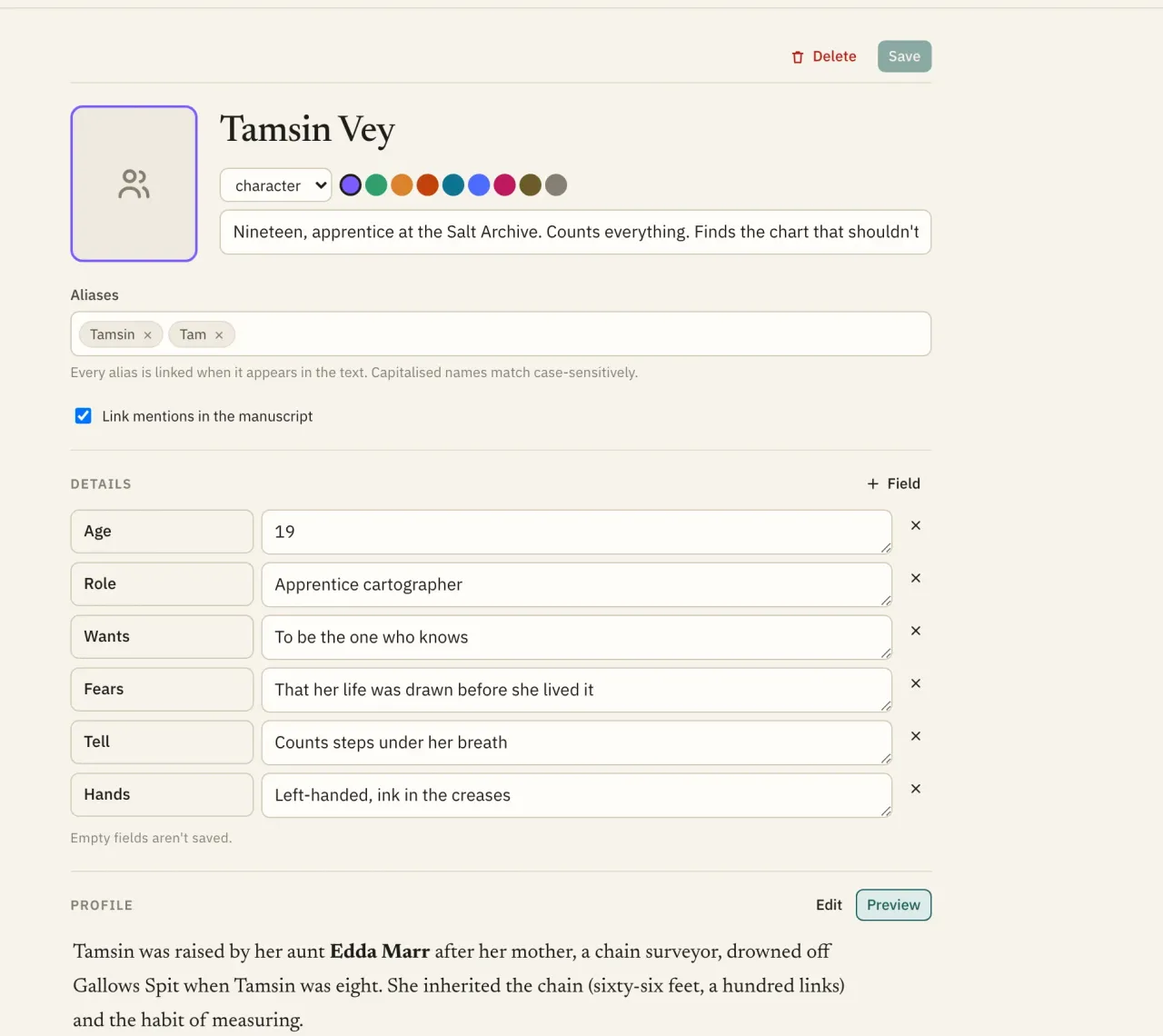
Authr's story bible (the codex) has entries for characters, places, items, groups, lore, concepts and events, each with suggested fields to fill in. Add the other names someone goes by, and Authr tracks every mention: each entry lists the chapters it appears in, with counts.
Relationships appear on a graph. The timeline lays out dated scenes and events by plotline and highlights flashbacks.
Every agent reads the bible before it works. Ask Continuity to check a chapter and it compares the text with the bible and the timeline, then leaves a note on anything that doesn't match. Writing a series? Share entries across every book.
Questions
Should I build the story bible before I start writing?
Build the essentials first: your main characters, key places and the rules of your world. Add everything else as it appears in the draft.
How detailed should a story bible be?
As detailed as the book needs and no more. Record what appears on the page or limits what can. A one-line summary and a few facts per entry beat pages nobody reads.
What's the difference between a story bible and an outline?
The outline is the order of events. The story bible is everything that stays true across them: who people are, what places are like, how the world works and when things happened.