How to edit your novel
Edit from the outside in: structure first, then scenes, then sentences. Here's the order, and where AI editors help.
- Rest the draft for a few weeks, then read it straight through.
- Fix structure before you touch a single sentence.
- Do one pass per kind of problem, not one pass for everything.
- Use AI for diagnosis and line notes. Keep the decisions.
Rest, then read it like a reader
Put the draft away for at least two weeks. Then read the whole thing in as few sittings as you can, ideally in a different format: on a tablet, printed out, or read aloud.
Don't fix anything yet. Just make notes: where you got bored, where you got confused, where it worked.
Then write a one-page summary of the book as it actually is, not as you planned it. The gaps between the two are your revision plan.
Pass 1: Structure
This is the big, expensive pass. Ask:
- Does the main character want something clear, early?
- Does the story start in the right place? First drafts often start too early. The real opening is sometimes in chapter two or three.
- Does the middle build, or just repeat?
- Does the ending pay off what the opening promised?
- Is any subplot or character doing nothing?
Make a scene list: one line per scene, saying what changes. Mark every scene where nothing does. Cut it, merge it, or move it.
Don't polish sentences yet. There's no point perfecting a chapter you're about to cut.
Pass 2: Scenes
Go scene by scene. In each one, someone should want something, meet resistance, and end up better or worse off.
Enter as late as you can and leave as early as you can. Most scenes improve when you cut the first and last paragraph.
Check point of view. Are you staying in one head per scene? Check pacing too. Tense scenes need quieter ones around them so the reader can breathe.
Pass 3: Lines
Now the sentences. Look for:
- Filter words: she saw, he felt, she noticed. Show the thing directly.
- Repetition of words and sentence shapes.
- Adverbs propping up weak verbs.
- Dialogue tags fancier than "said" and "asked".
- Your personal tics. Everyone has a few: just, really, suddenly, a sigh in every scene.
Read it aloud. Your ear catches clumsy rhythm that your eye skips.
Pass 4: Proofread
Last of all: typos, punctuation, and consistent spelling of names and invented words. Use a different format again. You'll see errors you've read past twenty times.
Save a version before each pass
You will cut something you later want back. Keep a copy of the draft before each pass so you can.
Get readers between passes
After the structural pass, give the book to two or three readers. Ask what confused them, where they got bored and which character they cared about most.
When two readers stop at the same place, there's a real problem there, even if their suggested fixes are wrong. The fix is your job. The location is the useful part.
Know when to stop
At some point your changes stop making the book better and only make it different. If you're swapping words back and forth, or restoring things you cut a month ago, you're done. Send it out.
Where AI editors help, and where they don't
AI is good at the tiring parts: spotting where pacing drags, flagging a fact that contradicts chapter two, noting repetition, and reacting as a first reader at any hour.
It's bad at knowing what your book is meant to be. Left alone, it smooths every voice toward the average. So use it for diagnosis, not decisions. Ask for notes before rewrites. Take its edits one at a time, and say no often.
If you plan to publish, a good human editor is still worth it. AI is a useful pass before you pay for one, not a replacement.
Doing this in Authr
Import your draft from Word, Markdown or plain text. Headings become chapters and scenes. Take a snapshot called "Draft 1" before you start, so you can always go back.
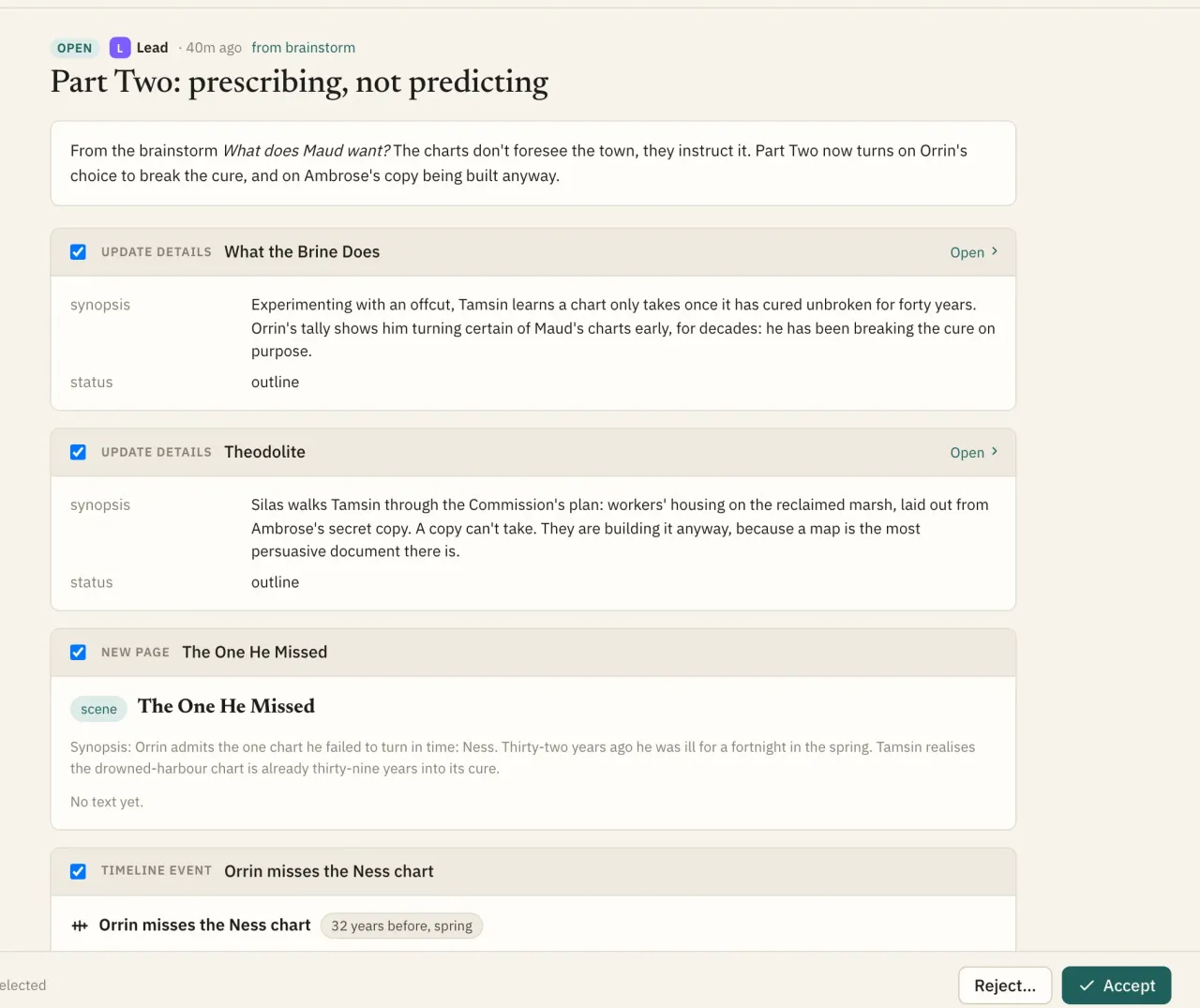
Each pass has an agent. The Reviewer works like a developmental editor: notes on structure, stakes and pacing, pinned to the passage, and it never rewrites. The Beta reader tells you where it got bored or lost. Continuity checks against your story bible.
The Line editor suggests small edits that appear under each paragraph. Accept or reject each one, or reject with a note and it tries again. Listen reads your page aloud, sentence by sentence.
Questions
How many drafts does a novel need?
There's no fixed number. Most novels go through a structural revision, a scene-level pass and a line edit. Some passes take several rounds.
Should I hire a human editor?
If you plan to publish, usually yes. Self-editing first, with AI notes to catch the obvious, means you pay a human editor for the problems only a person can see.
Can AI edit my whole novel?
It can give notes on the whole book. But accepting a whole book's worth of edits without reading them is how you lose your voice. Review changes one at a time.