How to finish your first draft
Most first novels don't fail. They stop. Here's how to keep going until you write the last line.
- Set a daily target small enough to hit on a bad day.
- Don't revise while you draft. Leave a note and keep moving.
- When you're stuck, skip ahead or write the scene badly.
- Track your progress so you can see the finish line.
Why drafts stall
There are usually three reasons. You keep rewriting chapter one. You reach the middle and don't know what happens next. Or life takes the time. Each one has a fix.
Set a target you can hit on a bad day
If you've never written 500 words a day, don't aim for 2,000. A small target you hit every day beats a big one you miss.
The maths is kind: 500 words a day is about 90,000 words in six months. That's a novel.
Write at the same time each day if you can. Count the days you write, not just the words. Missing one day is fine. Missing two in a row is how a habit ends.
Don't edit while you draft
A first draft is for finding out what happens. Editing is a separate job, and it comes later.
When you notice a problem, leave a note and keep going: [fix: she already knows this]. If you need a fact you don't have, write [check] and move on. Don't go back to chapter one until you've reached the end.
Your early chapters will change anyway once you know how the book ends. Polishing them now is work you'll throw away.
When you're stuck
- Skip it. Write the scene you can see clearly, and come back to this one later.
- Write it badly. Summarise it in plain sentences: "She goes to the bank. He's there. They argue about the money." A placeholder is better than a blank.
- Ask what someone wants. Stuck scenes often have nobody wanting anything. Give a character a goal for this scene and someone in the way.
- Raise the stakes or cut it. If you're bored writing it, a reader will be bored reading it.
- Look back, not forward. A block is often the story telling you that a choice three scenes ago was wrong. Note it. Don't fix it yet.
Getting through the middle
The middle is where most drafts die. Three things help.
Give it a midpoint: a reveal or reversal that changes the direction of the story. Give your antagonist a plan of their own, so things happen even when your hero is passive. And make things get worse, not just longer.
Protect the time
Write before you check messages. Short sessions count: 25 focused minutes is often enough for 300 to 500 words.
Stop mid-scene, when you know what happens next. Tomorrow's session then starts with something easy, which is the hardest part of any session.
Tell someone your finish date. It's easier to keep a promise you've said out loud.
When you want to start something else
Somewhere around a third of the way through, a new idea will arrive that seems far better than the book you're writing. It always does. The new idea looks perfect because you haven't written it yet.
Write it down in a few lines, put it in a folder, and go back to your draft. It will still be there when you finish.
Don't share it too early
Feedback on a half-finished draft tends to pull you back into rewriting the beginning. Unless a reader keeps you motivated, wait until you have a complete draft. Then you'll know which notes matter, because you'll know how the story ends.
Finish, then rest
When you write the last line, stop. Put the draft away for a few weeks before you start editing. You'll come back reading it as a reader, not as the person who wrote it, and the problems will be much easier to see.
A finished bad draft can be fixed. An unfinished good one can't.
Doing this in Authr
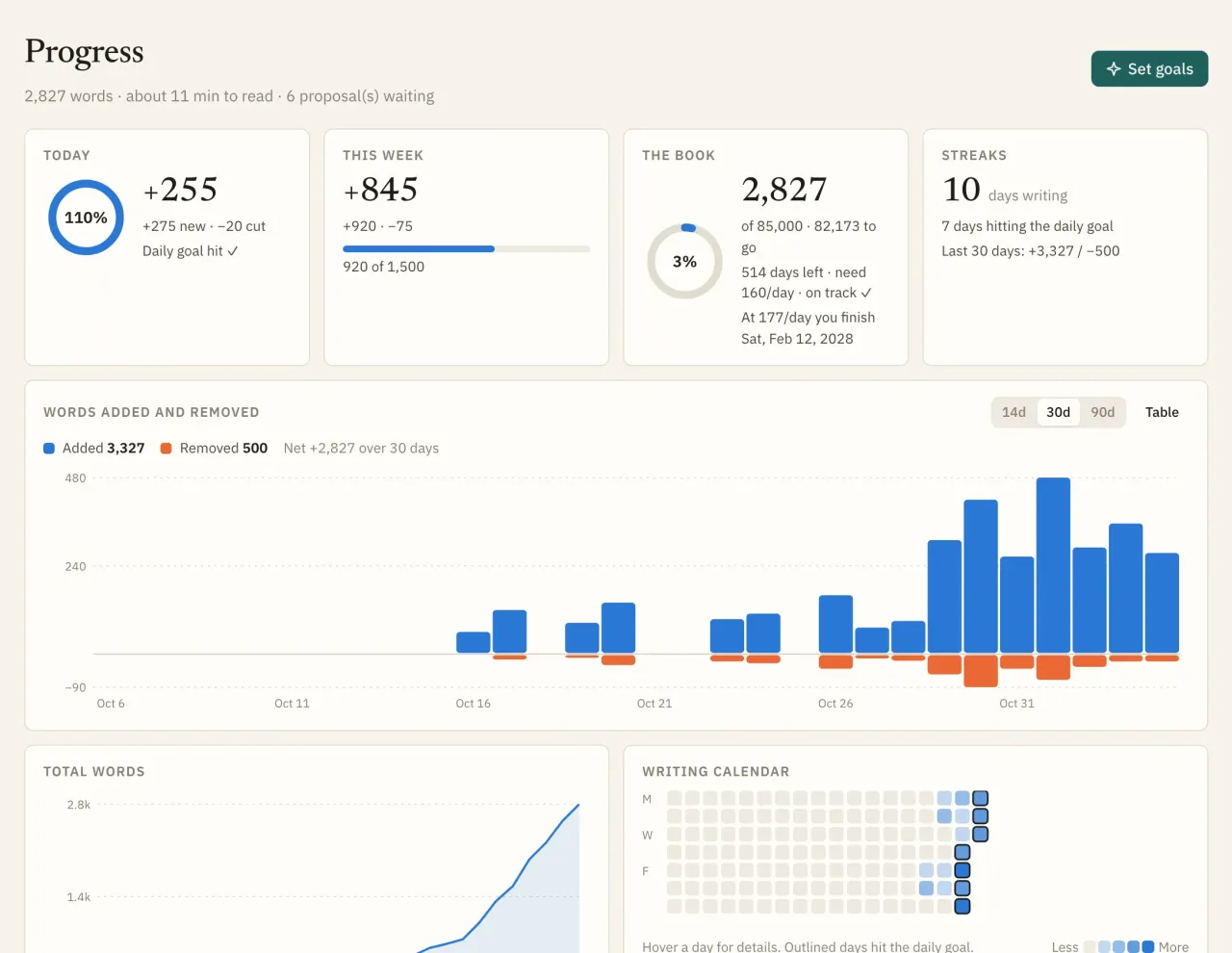
Set a daily goal, a weekly goal and a deadline on the Progress page. Authr shows your writing streak, the words you have left, and a projected finish date at your recent pace. It counts words added and cut, so a day of rewriting still shows up.
Focus mode hides everything but the page. Leave yourself notes as comments instead of stopping to fix things.
When you can't see the next scene, brainstorm it with the Lead, who has read the book so far. Some writers ask the Writer for a rough version of a scene from its synopsis, just to have something to react against and rewrite in their own words.
Questions
How long should a first draft take?
Many writers take six months to a year for a first novel. At 500 words a day, a 90,000-word draft takes about six months.
How many words a day should I write?
As many as you can manage on a bad day. For most people starting out that's 250 to 500. You can raise it once the habit holds.
Should I edit as I go?
Mostly no. Fix a typo if it bothers you, but leave bigger problems as notes. Editing early chapters before you know the ending usually means editing them twice.