AI beta readers and editors
AI can tell you where your book drags and what doesn't add up. Here's how to get notes that help, without your book starting to sound like everyone else's.
- Ask for notes, not rewrites.
- Give each AI reader one job: structure, reactions, continuity or lines.
- Tell it who your reader is and what the scene is meant to do.
- Accept edits one at a time, and say no often.
The problem with "make it better"
Paste a chapter into a chatbot, ask it to improve it, and you get back something smoother, more generic and less yours. AI writes toward the average. It also tends to flatter.
Both problems come from asking the wrong question. Ask better ones and AI becomes a genuinely useful reader.
Give each reader one job
Publishing splits editing into roles for a reason. Do the same with AI:
- Developmental editor. Structure, stakes, motivation, pacing. Should never rewrite.
- Beta reader. Reacts as your target reader: hooked, bored, confused, what they expect next.
- Continuity checker. Names, ages, dates, travel times, who knows what.
- Line editor. Clarity, rhythm, repetition. Small edits, each one separate.
- Specialist reader. One lens: medical accuracy, a period, a culture, a sensitivity read.
Ask one AI to do all of this at once and you get shallow notes on everything.
Give it context
Tell it the genre, who the reader is, and what this scene is supposed to do. "This is where the reader should first suspect Ana. Does the clue land without being obvious?" gets far better notes than "Thoughts?".
Ask for located, specific notes
Ask it to quote the exact passage each note is about. Ask for the three biggest problems, not every problem. Ask what works, too, so you know what not to cut. Tell it you want honesty, not reassurance.
Prompts that work:
- Read this chapter as a fan of literary thrillers. Mark the exact line where you'd stop reading, if any, and say why.
- List three places where the stakes are unclear. Quote each one. Don't suggest fixes yet.
- Check this scene against these facts and list contradictions only.
- Suggest line edits for rhythm and repetition only. Leave the dialogue alone. Give each change its own reason.
Protect your voice
- Write a style guide. Tense, point of view, spelling, words you never use, how you punctuate dialogue. Give it every time.
- Prefer suggestions to rewrites. Review every edit on its own. If you accept everything, you've stopped editing.
- Reject freely, and say why. "Too formal for her" makes the next round better.
- Don't hand over a chapter you love. Ask for a diagnosis, then fix it yourself.
- Watch for its habits. Tidy endings, explaining the subtext, naming emotions the scene already shows.
Let it read the whole book
Many of the most useful notes are about the whole book: a setup in chapter two that never pays off, a character whose motive changes without reason, a midpoint that arrives too late. A reader that only ever sees one chapter can't catch these.
So give an AI reader the full manuscript, or at least the outline and the chapters before the one you're asking about. Otherwise it will judge each chapter as if it were the opening.
Turn notes into decisions
Sort every note into three piles: agree, disagree, not sure. Act on the first pile. Ignore the second without guilt. Leave the third for a day, then decide.
A note can point to a real problem and still suggest the wrong fix. "Cut this scene" often means "this scene is slow". You might speed it up instead.
And treat praise as information. If a reader loves a line, it's a line to protect when you revise.
AI readers and human readers
AI notes are fast and free at two in the morning. But an AI has never been bored the way a person gets bored. Use it to catch the obvious before you spend your human readers' goodwill. People will still tell you the thing that matters most: whether they cared.
Doing this in Authr
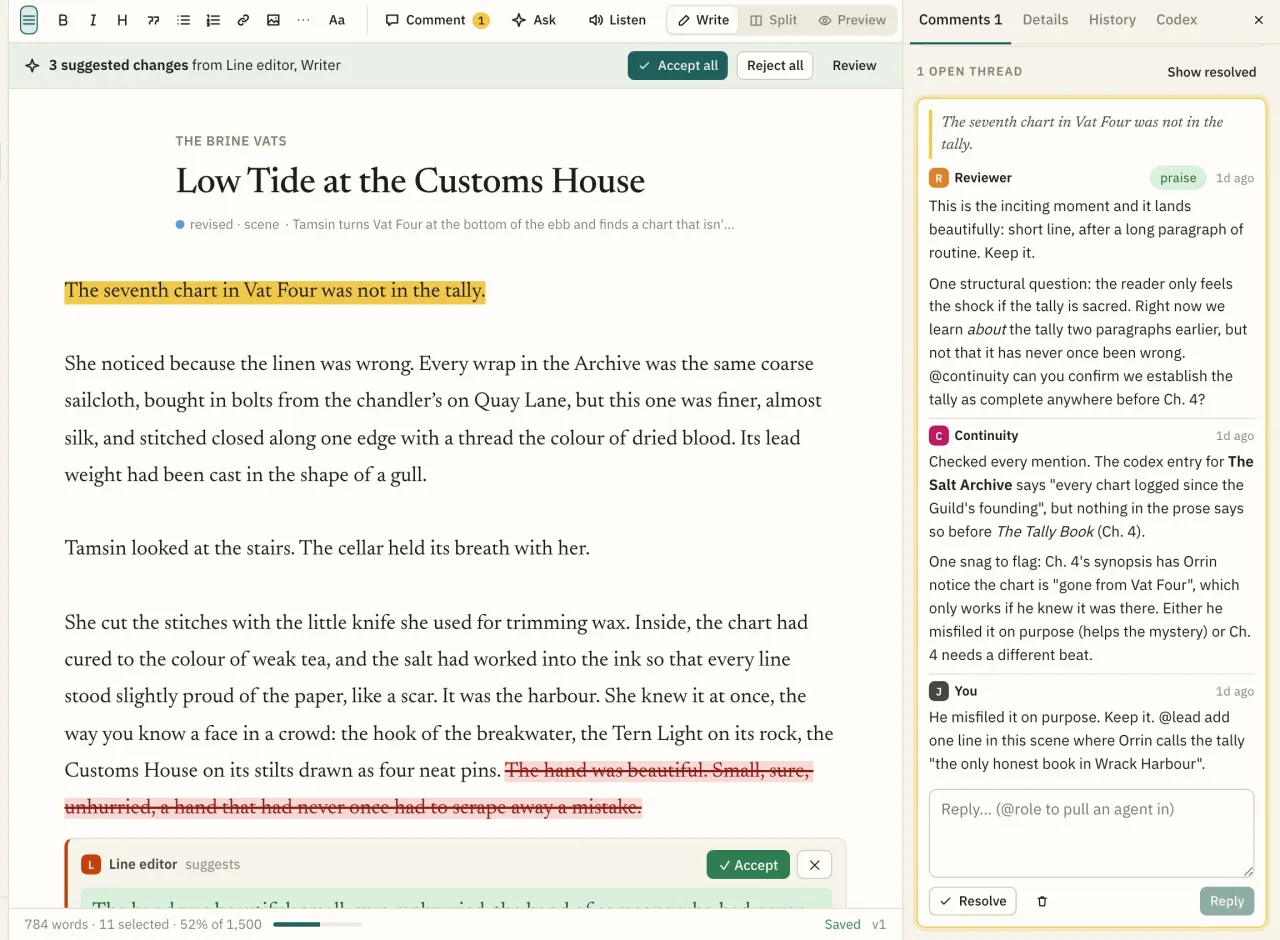
Authr gives you these readers as separate agents: Reviewer, Beta reader, Continuity and Line editor, alongside a Lead, Writer and Researcher. Highlight a passage and ask one of them, and the note lands in the margin on that exact line.
The Reviewer and Beta reader only comment. They never touch your text. The Line editor's changes appear as suggestions under each paragraph; accept or reject each one, or reject with a note and it revises. Every agent reads your style guide first.
Need a particular lens? Create your own agent, such as a sensitivity reader, with its own instructions.
Questions
Will AI make my writing sound generic?
It will if you let it rewrite freely. Ask for notes instead, give it your style guide, and accept edits one at a time.
Can an AI beta reader replace human beta readers?
No. It's a good first reader that catches confusion, slow patches and contradictions. Human readers tell you whether they cared, which AI can't.
What should I ask an AI beta reader?
Specific questions about specific passages. Where did you get bored? What do you think happens next? Which character do you trust least? Ask it to quote the line each answer is about.